This Thanksgiving, we want to do something a little different. Instead of asking what the markets will do tomorrow, we want to ask where we'd like to be five years from now, and what we'll be thankful for when we get there.
Friday Was Painful. Monday Reminded Us How Quickly Things Can Change.
Let's start with last week. On Friday, November 20, the S&P 500 fell 3.7%, the Nasdaq dropped 5.3%, and the Dow lost nearly 950 points. For the week, the S&P 500 fell about 8.6% and the Nasdaq about 10%, and both the S&P 500 and the Dow closed in correction territory, more than 10% below their highs.
Concerns about technology valuations, artificial intelligence spending, and corporate profitability drove much of the selling. Those are significant declines, and we don't want to minimize the financial or emotional impact they can have.
Then came Monday. Stock futures pointed to a rebound early in the morning, and the rally held through the close.
The S&P 500's gain of nearly 327 points on Monday was one of the largest one-day point gains in its history, sparked in part by Nvidia's decision to reinstate Jensen Huang as CEO.
The contrast between Friday and Monday illustrates something important: markets can change direction much faster than our emotions can adjust. When markets fall sharply, it's natural to feel concerned. When they rally, we suddenly feel better. But should our outlook for the next five or ten years really change that much between Friday afternoon and Monday morning?
We don't believe it should. One strong day doesn't erase the concerns behind last week's selloff, and one bad week doesn't define the next decade. That's why we think long-term perspective is so valuable.
Let's Go Back Five Years. Look How Far We've Come.
On November 19, 2021, the S&P 500 closed at about 4,698. Last Friday, even after the selloff, it closed at about 6,910. That means the index was still about 47% higher than five years earlier, excluding dividends. After Monday's rally, the gap widened to roughly 54%.
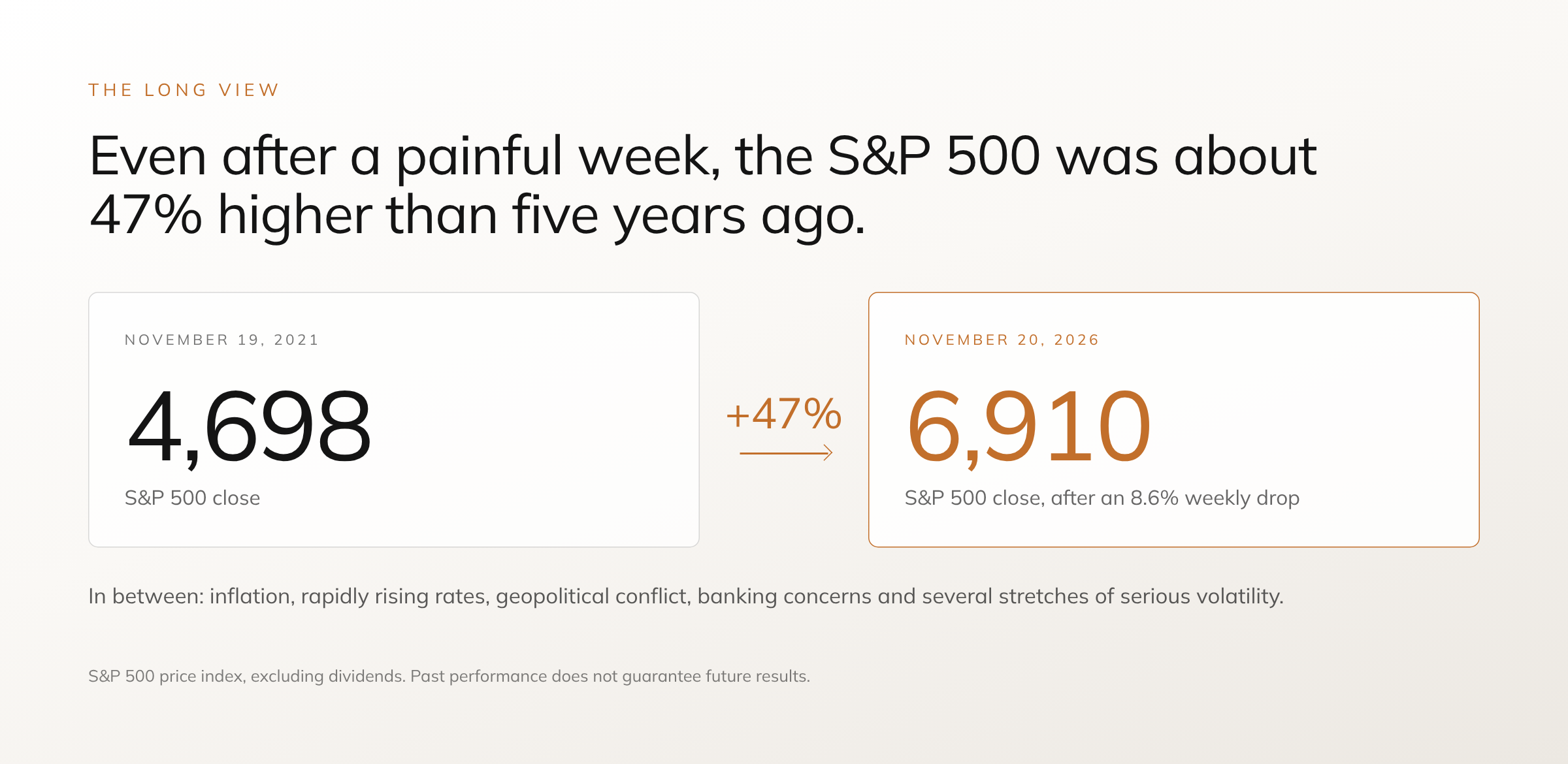
Over those five years, investors lived through inflation, rapidly rising interest rates, geopolitical conflicts, banking concerns, technology disruptions, and several stretches of serious volatility. Yet the broad U.S. stock market still advanced considerably.
That doesn't mean every investor earned 47%, and it certainly doesn't mean the next five years will produce the same result. Individual investments, purchase dates, taxes, fees, and dividends all affect actual returns. But it does show why looking at markets over longer periods can give a completely different perspective.
What if we measured our financial progress in five-year increments instead of five-day increments?
Imagine looking back in November 2031. Will we remember exactly how much the Nasdaq fell on November 20, 2026? Probably not. But we may remember the decisions we made during difficult times:
Did we continue saving and investing appropriately?
Did we manage our debt?
Did we protect our families financially?
Did we purchase assets that made sense for our long-term goals?
Did we stay patient when things became uncomfortable?
Those are the decisions that can shape our financial future.
Your Financial Future Is Bigger Than the Next Market Correction
One of the biggest challenges investors face is separating short-term emotions from long-term financial decisions. When markets are climbing, we feel confident. When they're declining, we start questioning everything.
Volatility has always been part of investing. It doesn't disappear because technology improves or the economy grows. In fact, as information travels faster and more investors react to headlines instantly, short-term moves can feel even more intense.
That's why we like the idea of thinking in five-year chapters.
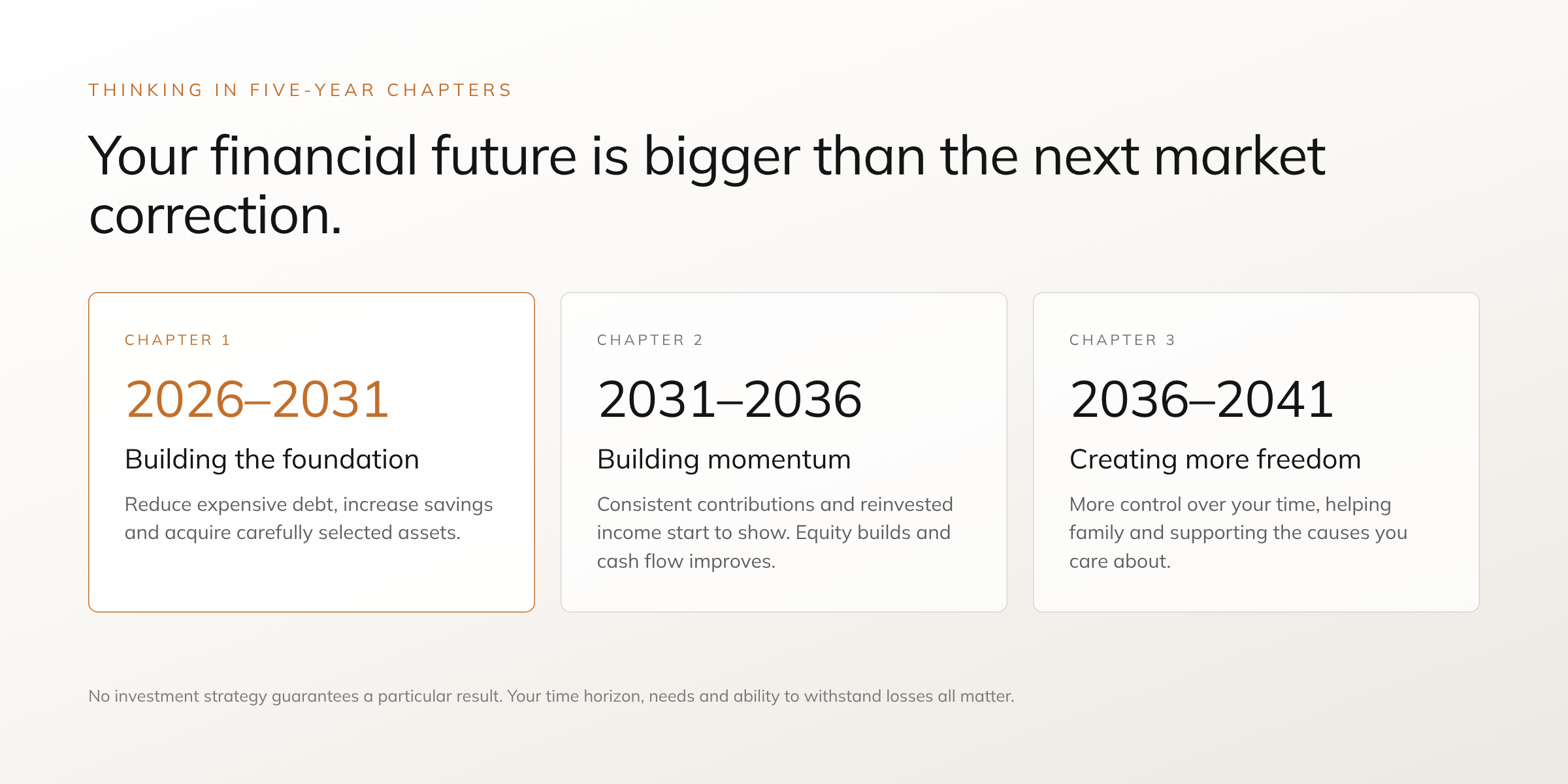
2026–2031: Building the foundation. Strengthening your financial position, reducing expensive debt, increasing savings, acquiring carefully selected assets, and preparing for future opportunities.
2031–2036: Building momentum. Over time, consistent contributions, reinvested income, and disciplined decisions may begin producing meaningful results. For real estate investors, that could include building equity, reducing mortgage balances, and improving rental cash flow.
2036–2041: Creating more freedom. The long-term goal may not simply be accumulating more money. It could be having more control over your time, helping your children or grandchildren, supporting causes you care about, or enjoying retirement without constantly worrying about finances.
No investment strategy guarantees a particular result. Your time horizon, financial needs, and ability to withstand losses all matter.
Our Take: A long-term plan won't stop the headlines, but it can keep today's headlines from controlling tomorrow's decisions.
Technology Gives Us Reasons to Be Excited
When we look at how much has changed in just the past five years, it's remarkable. In 2021, most people weren't regularly using conversational artificial intelligence for their work, research, business planning, or daily lives. Today, AI is becoming part of how companies operate and how people get things done, and we're still early in understanding its long-term impact.
One striking finding comes from Stanford University's 2025 AI Index Report. The cost of using an AI model performing at the level of GPT-3.5 on a common benchmark fell from about $20 per million tokens in November 2022 to just seven cents by October 2024. That's a reduction of more than 280 times in roughly two years.
Technology that once required substantial resources is becoming accessible to small businesses, entrepreneurs, schools, and individuals. Imagine what another five years of improvement could bring:
For small businesses: better customer service, automated scheduling, improved bookkeeping, more efficient marketing, and faster access to information.
For real estate: tools that help investors analyze properties, compare rental opportunities, estimate renovation costs, and evaluate risks much faster than we can today.
For families: more personalized education, easier communication, and tools that help organize everyday responsibilities.
Some of these capabilities already exist in early forms. Others will need more development, oversight, and adoption. AI also brings real challenges involving employment, privacy, security, energy use, and the accuracy of information.
Our Take: AI's potential to increase productivity and make valuable services more accessible is worth being excited about. But the success of a technology doesn't guarantee the success of every company or stock tied to it, as last week reminded us. We can be optimistic about innovation while staying disciplined about investments.
Quantum Computing: Could Another Major Breakthrough Be Coming?
Traditional computers process information using bits. Quantum computers use quantum bits, or qubits, which behave differently because of quantum-mechanical properties. They aren't simply faster versions of today's computers. Researchers are developing them to tackle certain kinds of calculations that are extraordinarily difficult for traditional machines, with potential uses in chemistry, materials science, scientific simulation, and some specialized optimization problems.
The challenge has been making quantum computers reliable enough to do useful work at scale. Quantum information is extremely sensitive to errors, which is why error correction is such an important part of current research.
Here's the exciting part. IBM's published roadmap targets a fault-tolerant quantum computer called Starling in 2029. IBM says the system is planned to use 200 logical qubits and run 100 million quantum operations, with more powerful systems planned beyond that. These are development targets, not guaranteed delivery dates, but they show major companies working toward specific milestones within the next five years.
Over time, more capable quantum systems could help scientists simulate molecular behavior that's hard to model today, which might support research into new drugs and treatments. Researchers also hope quantum computing can help them develop better materials for batteries and electronics, and improve work in energy and industrial chemistry.
Our Take: We want to be careful here. None of this means quantum computers will cure diseases, solve energy shortages, or transform every industry by 2031, and commercially useful applications still face big scientific and engineering hurdles. But we're living through a period when scientists are making progress toward computing capabilities previous generations could only imagine. That's worth looking forward to.
Our Health May Be the Most Important Investment of All
With all this talk about markets and future technology, we want to bring things back to something more personal: our health.
We can spend years building businesses, investing in properties, saving for retirement, and working toward financial security. But what good is financial success if we don't have the health or the time to enjoy it?
Thanksgiving is a great time to ask ourselves a few honest questions. Are we making time to exercise? Are we getting enough rest? Are we managing stress? Are we making time for our spouses, children, grandchildren, parents, and friends?
Medical technology keeps advancing, and we're hopeful that AI and other innovations will help doctors detect diseases earlier and improve treatments. But we don't have to wait for future breakthroughs to make better decisions today. Sometimes the most valuable investment we can make is a walk with our spouse, time outside with our kids, some exercise, or simply slowing down.
Those moments won't show up on a financial statement, but they can be some of the most valuable returns we ever receive.
Remembering Families Affected by War and Hardship
We also don't want to overlook what people are facing around the world. The continuing war in the Middle East has caused enormous hardship. Families have been displaced, lives have been lost, and communities have been affected in ways that go far beyond financial markets.
We often talk about these events in terms of oil prices, inflation, or economic consequences. But behind those headlines are real people: parents, children, and grandparents who want many of the same things we want, which are safety, stability, opportunity, and a future for the people they love.
As we gather around our Thanksgiving tables, we hope we can remember those who are suffering and those who can't be with their loved ones. It's also a reminder that even during our own difficult financial stretches, there may be things that deserve our gratitude: a safe home, a healthy family member, a friendship, work that provides for our needs, the chance to begin again after a setback, and the freedom to plan for a better future.
Being thankful doesn't mean pretending life is easy. Sometimes gratitude is simply recognizing what remains good even when other things are hard.
Real Estate and Building a Legacy: Think Beyond Today's Interest Rate
Mortgage rates remain frustratingly high. Freddie Mac reported the average 30-year fixed rate rose to 7.28% on November 19, up from 7.11% the week before. That ended four straight weeks of declines.
| Survey Date | Average 30-Year Rate |
|---|---|
| October 15 | 7.40% |
| October 22 | 7.32% |
| October 29 | 7.24% |
| November 5 | 7.18% |
| November 12 | 7.11% |
| November 19 | 7.28% |
That isn't the direction buyers and investors were hoping for. But real estate is generally a long-term investment. A property purchased today may be owned for five, ten, twenty, or even thirty years, and over that time an investor may see changes in property values, rental income, expenses, financing options, and the amount of debt owed.
None of those outcomes is guaranteed. Some properties will underperform, and some markets may see prolonged declines. That's why buying at the right price and understanding cash flow matter so much.
When we think about building a real estate portfolio, we're not only thinking about what rates will do next month. We're thinking about what that portfolio could provide a family ten or twenty years from now:
Could it create additional retirement income?
Could it help pay for a child's education?
Could it eventually be passed along to the next generation?
Could it provide financial flexibility and more time with family?
Our Take: The goal isn't simply to own more assets. It's to create more opportunities for the people and things we care about.
A Simple Thanksgiving Exercise: Where Do You Want to Be in 2031?
Here's something we'd encourage everyone to try over the holiday. Take a little time away from the market headlines and think about what you'd like your life to look like five years from now. Not just your investment accounts, your entire life.
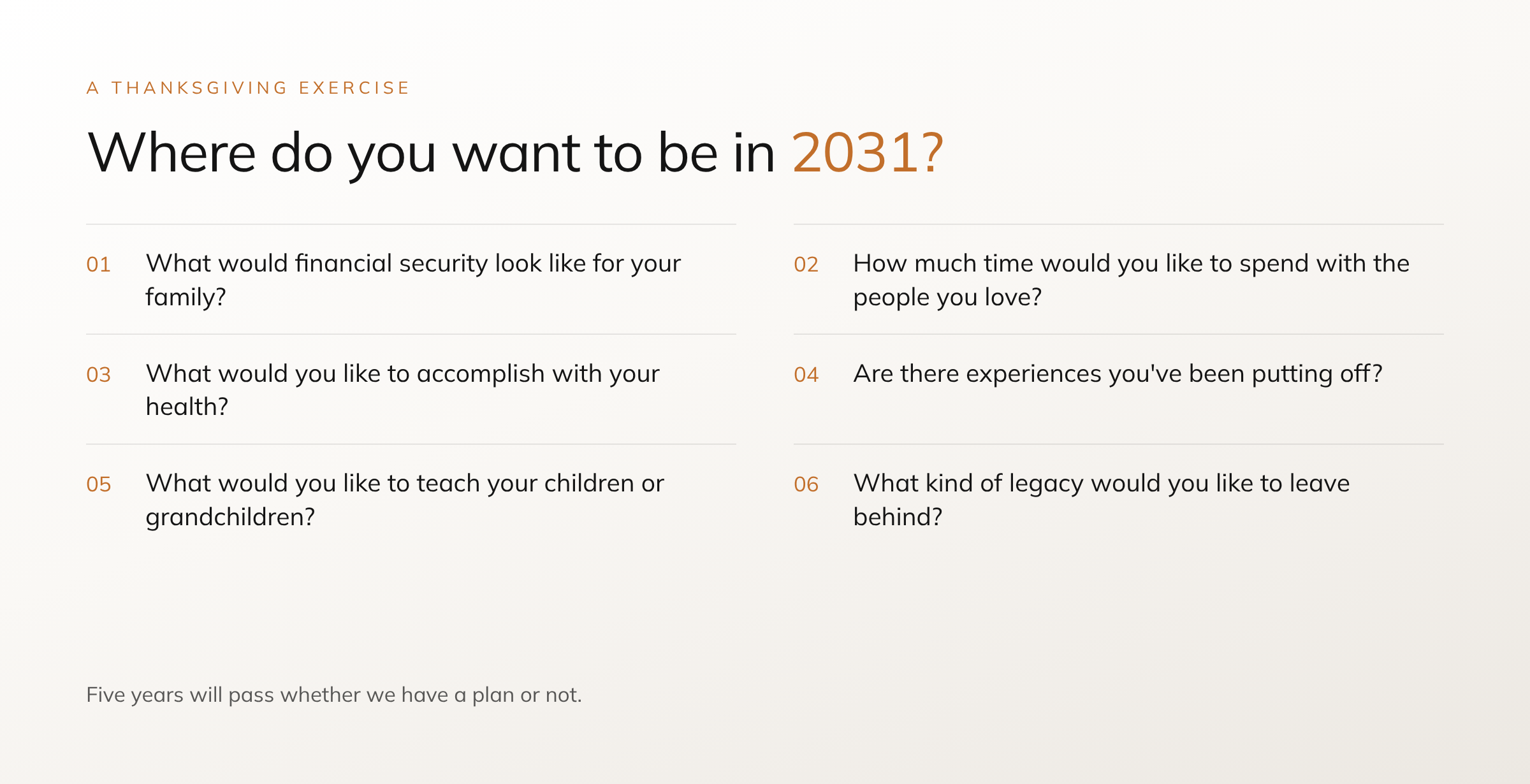
What would financial security look like for your family?
How much time would you like to spend with the people you love?
What would you like to accomplish with your health?
Are there experiences you've been putting off?
What would you like to teach your children or grandchildren?
What kind of legacy would you like to leave behind?
Once you've thought about those questions, consider what decisions you can start making today to move in that direction. It doesn't have to be a major investment. It might be a savings plan, paying down expensive debt, reviewing your retirement goals, spending more time with family, or improving your health.
The important thing is having a direction, because five years will pass whether we have a plan or not.
Our Outlook: There Are Reasons to Be Hopeful
We don't want anyone to misunderstand this week's message. There are real economic risks ahead. Inflation remains a challenge. Interest rates are elevated. Some stock valuations are hard to justify. The war continues, and global markets remain closely connected. There could be more market declines, and nobody knows exactly when volatility will settle down.
But there are also reasons to be optimistic. Businesses keep developing new technologies. Scientists are making progress in medicine and computing. Entrepreneurs are finding new ways to solve problems. Families are working toward financial independence. And investors still have opportunities to build wealth through disciplined, long-term decisions.
The next five years will almost certainly include surprises, setbacks, and difficult periods. They may also include innovations and opportunities we can barely imagine today.
Our Take: Optimism doesn't mean assuming everything will work out perfectly. It means recognizing the challenges while still having confidence that progress is possible. As we celebrate Thanksgiving, that seems like a pretty good reason to be grateful.