

The biggest story this week is the disconnect between mortgage rates and the bond market. Freddie Mac reported another decline in mortgage rates, yet the 10-year Treasury yield jumped sharply as inflation concerns returned. Is this the start of a lasting improvement in borrowing costs, or could mortgage rates turn higher again?
We'll also look at new Treasure Valley housing data, plus Japan, the yen carry trade, and oil prices, all of which could ripple through our markets.
Wall Street Rebounds, but Technology Remains a Concern
The stock market finally put together a winning week, recovering some of the weakness we've seen since early October.
Friday itself was less encouraging. The S&P 500 slipped 0.4% and the Nasdaq fell 0.9% as technology shares weighed on the market. The unexpected resignation of Nvidia CEO Jensen Huang added uncertainty around one of the most influential companies in artificial intelligence, at a time when investors are already questioning the enormous sums being spent on AI infrastructure.
AI may transform productivity over the coming years, but tremendous potential isn't the same thing as an attractively priced investment.
Our Perspective: We're watching whether volatility stays concentrated in technology or spreads into financials, industrials, and smaller companies. A pullback in highly valued tech stocks is not automatically a broad economic downturn.
Inflation Is Becoming a Bigger Concern Again
Last week's two inflation reports offered little reassurance.
Consumer prices: CPI rose 0.4% in October after a 0.6% increase in September. Core CPI (excluding food and energy) rose 0.3%. Shelter rose 0.3%, food 0.5%, and energy 0.7%.
Producer prices: Wholesale prices rose another 0.3% in October. More concerning, final-demand producer prices are up 6.5% over the past 12 months, the largest annual increase since November 2022. Excluding food, energy, and trade services, they're up 4.9%.
One unusual detail: the government didn't publish a standard annual CPI rate for most categories this month because comparable October 2025 data weren't collected during last year's federal funding lapse. That makes the monthly readings especially important.
Producer prices don't flow directly into consumer prices, but persistent cost increases can eventually squeeze business margins and household budgets. For real estate investors, that can mean higher costs for repairs, construction materials, insurance-related services, and day-to-day operations.
What about the Fed? The Federal Reserve held its benchmark rate at 3.75%–4.00% on October 28, with two members preferring another quarter-point increase. With inflation elevated and the economy adding 165,000 jobs in October, the Fed has little reason to assume inflation is under control. The next meeting is December 8–9.
Our Perspective: We're increasingly concerned that interest rates may stay elevated longer than many investors expect, especially if businesses keep passing along higher costs.
The Bond Market Just Delivered an Important Warning
This may be the most important development of the week for both stock and real estate investors.
The 10-year Treasury yield ended Friday near 5.15%, up from about 4.86% the previous Friday, a jump of roughly 29 basis points in one week. Investors are demanding higher returns to hold long-term government debt, likely due to persistent inflation, expectations of further Fed tightening, and uncertainty about future government borrowing.
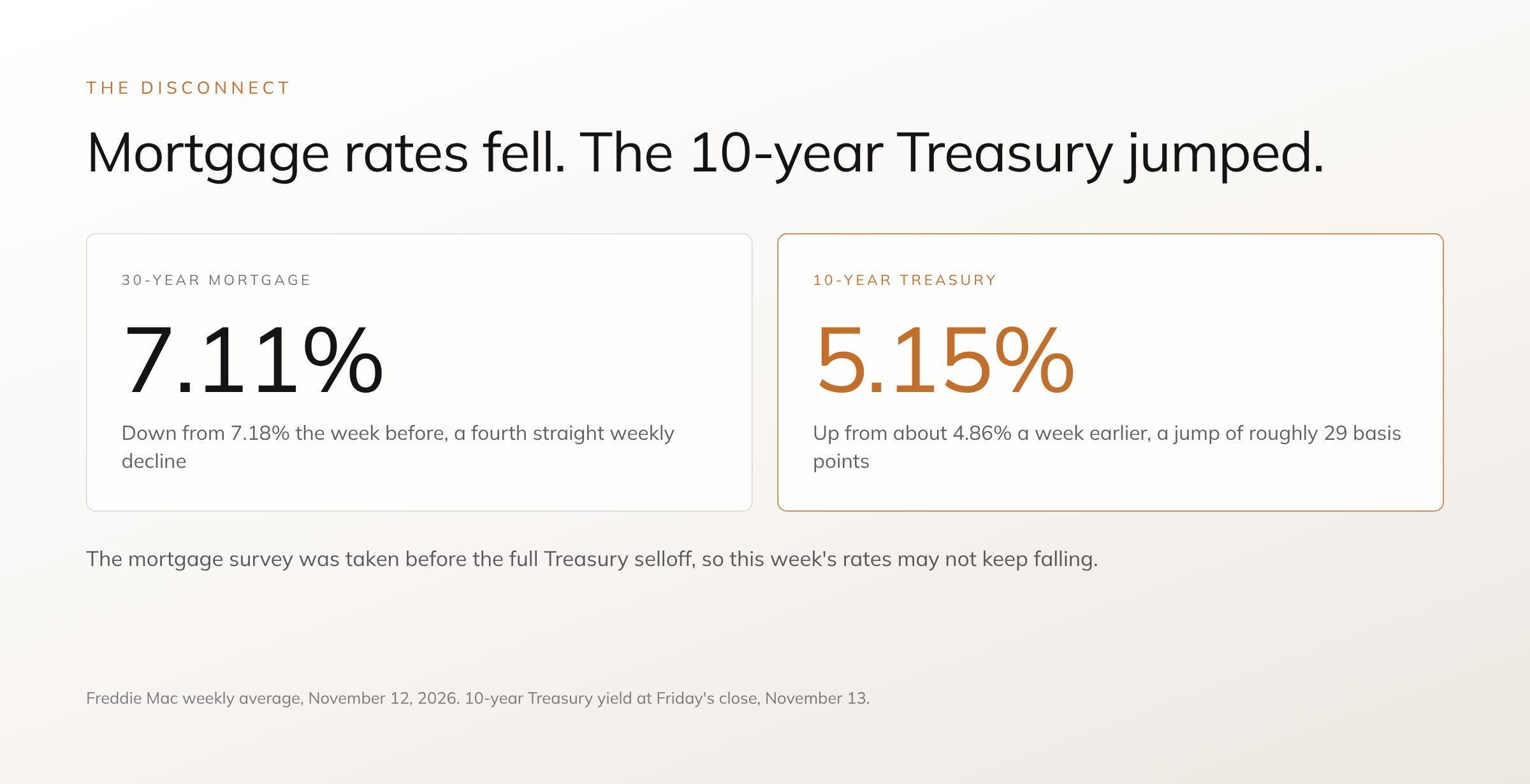
For stock investors, higher yields make bonds more competitive with stocks and put pressure on valuations built on future earnings. For real estate, the link is even more direct: the 10-year Treasury is a key benchmark for mortgage rates. A sustained move above 5% could make it difficult for mortgage rates to keep falling.
What We're Watching: Whether the 10-year stays above 5%, stabilizes, or moves lower. The trend over the next several weeks matters more than any single day.
Mortgage Rates Have Fallen Four Weeks in a Row, but There's a Catch
Freddie Mac reported the average 30-year fixed rate fell to 7.11% on November 12, down from 7.18% the week before. The 15-year fixed rate fell to 6.45%.
That helps affordability. The catch is timing: last Thursday's survey doesn't fully reflect the Treasury selloff that continued through Friday, so it may not reflect where lenders price loans this week.
Buyers under contract may want to talk with their lender about rate-lock options.
Investors evaluating properties should run their numbers on the financing available today, not on a hoped-for refinance.
Our Perspective: This week's mortgage-rate report will be telling. If rates reverse higher, some of the recent affordability improvement could disappear.
National Home Sales Fall to Their Lowest Pace Since 2010
The National Association of REALTORS® reported that October existing-home sales fell 5.5% from September to a seasonally adjusted annual rate of 3.75 million, the slowest pace since August 2010 and 8.8% below October 2025.
Yet the national median price still rose 0.4% from a year earlier to $416,700. Inventory stood at 1.59 million homes, or 5.1 months of supply.
The takeaway: activity is slowing sharply, but prices aren't falling uniformly. Many homeowners have substantial equity and mortgage rates far below today's levels, so they have little reason to sell. Buyers, meanwhile, are struggling with monthly payments. That combination lets sales volume drop without triggering widespread price declines, and it's why national headlines don't tell you what's happening here in Idaho.
Treasure Valley Real Estate: October Numbers Are In
According to Boise Regional REALTORS® and Intermountain MLS data, the local market remains relatively tight even as higher rates constrain buyers.
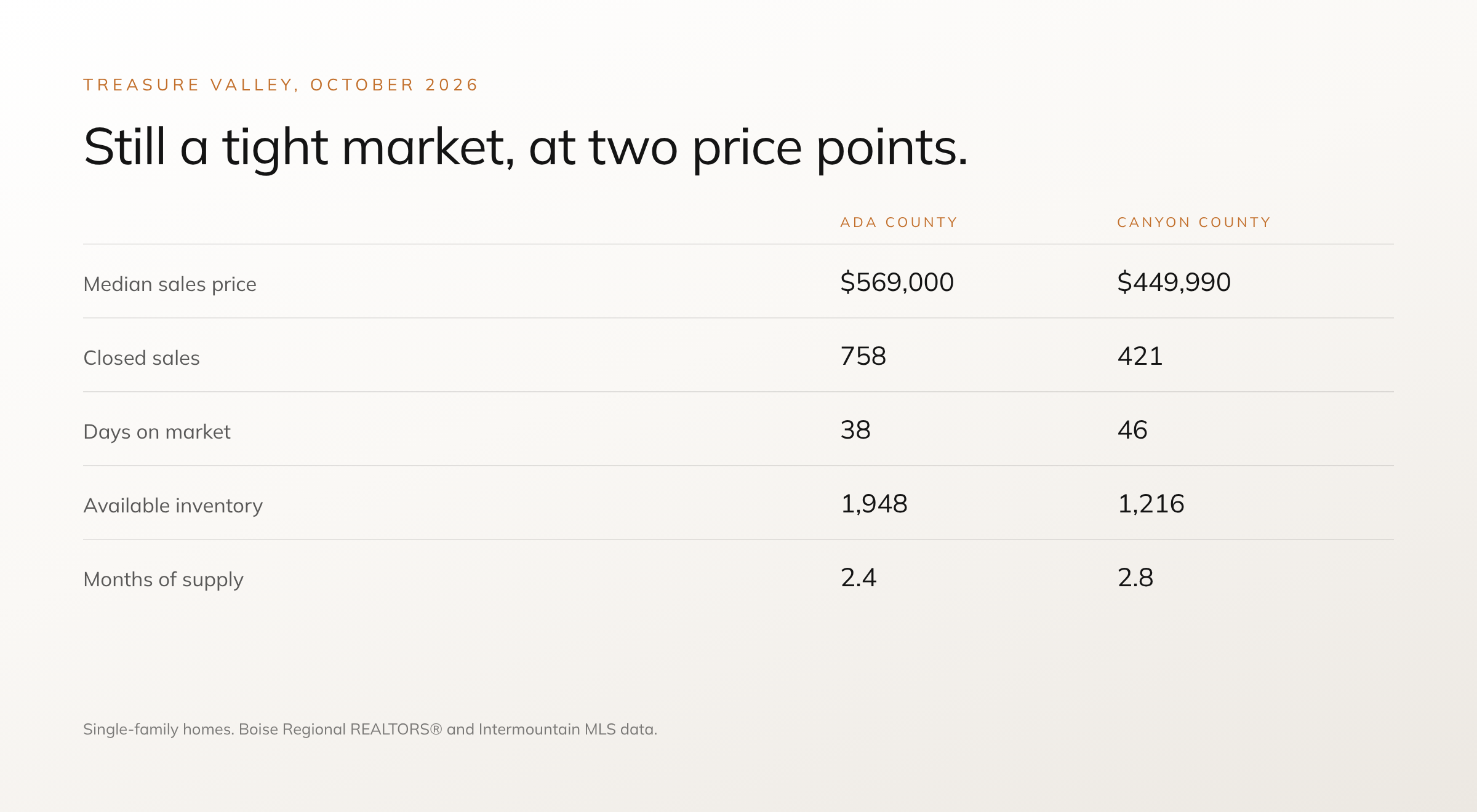
Ada County: Prices hold up despite fewer sales. The median price rose 3.5% from October 2025, even though closed sales fell 11.6%. Inventory dropped 8.3%, and pending sales rose 4.3%. Fewer homes are closing, but supply is limited and buyers are still writing contracts. That doesn't guarantee appreciation, but it explains why prices can stay firm even as financing gets more expensive.
Canyon County: A lower entry price. Canyon's median was about $119,000 below Ada's, which is one reason we keep watching Nampa, Caldwell, Middleton, and surrounding communities. But a lower price doesn't automatically mean a better investment. Rent, vacancy, insurance, taxes, maintenance, and long-term demand all need to support the decision, and a countywide median is no substitute for comparable sales on a specific property.
New Construction Could Be One of the Better Opportunities
In Ada County, the gap between existing homes and new construction is significant:
Existing homes: about 1.7 months of inventory, $556,000 median price, 31 days on market
New construction: about 3.7 months of inventory, $590,000 median price, 52 days on market
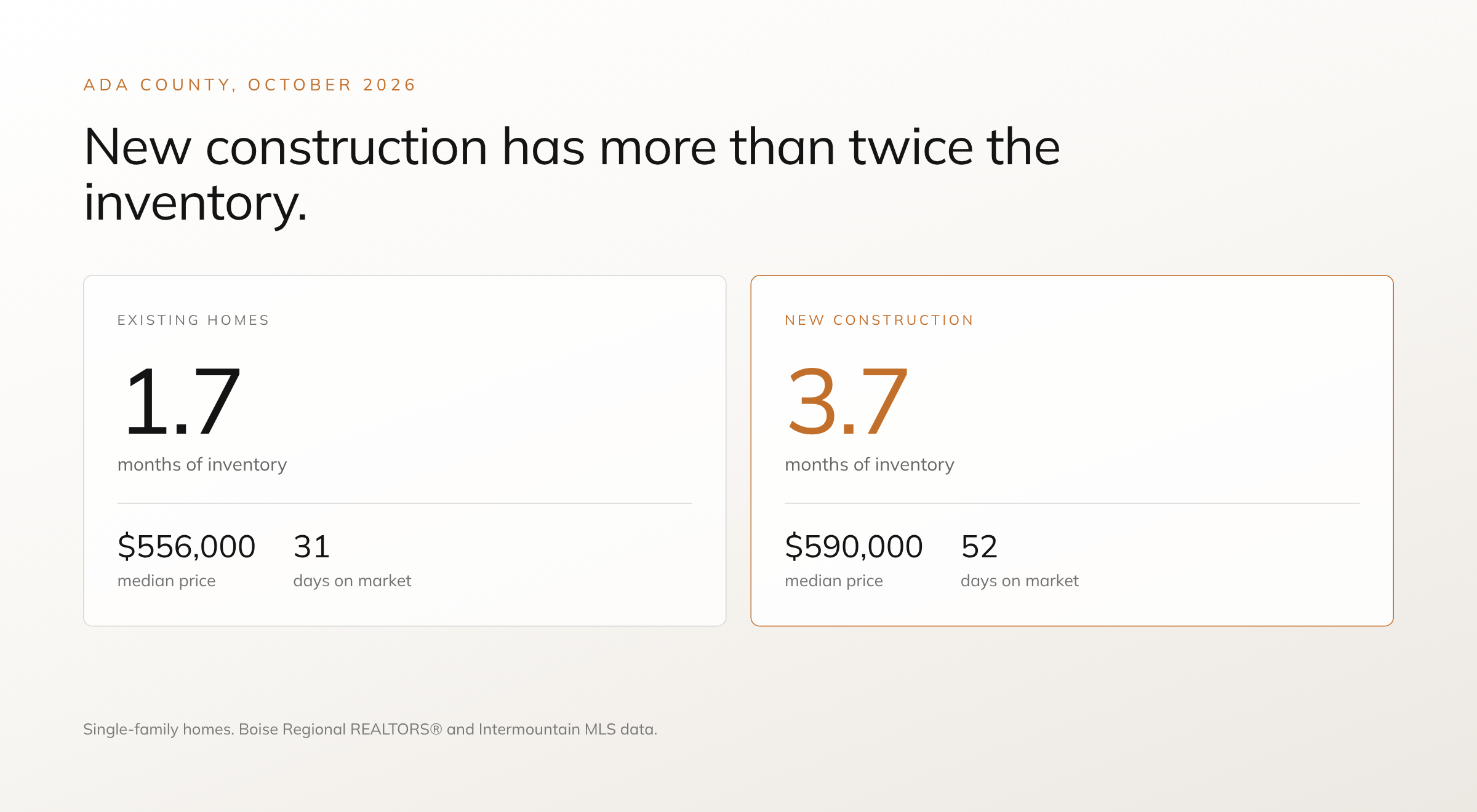
Builders carry real costs on finished homes (financing, taxes, insurance, and upkeep), which can create motivation to negotiate, especially heading into year-end. Look beyond the asking price at the total structure of the deal. A financing incentive or closing-cost contribution can sometimes be worth more than a straight price cut.
Locally, we're watching completed new homes that have been sitting, meaningful price reductions, and sellers who want to close before year-end. We're also watching how many similar homes hit the rental market in the same communities, since too much competing rental inventory can hurt both vacancy and rents.
Our Perspective: There are opportunities in this market, but investors need to be selective. Positive cash flow, good locations, and conservative assumptions matter more than ever.
Japan: Rising Bond Yields and a Weak Yen
Japan remains one of the most important international developments we're watching.
The Bank of Japan held its policy rate at 1.25% on October 30 but signaled further increases could be appropriate if inflation persists.
The 10-year Japanese government bond yield climbed to about 2.885% Monday morning, its highest level since October 22.
The yen has weakened to near 160 per dollar, renewing talk of currency intervention.
Japan's economy contracted at a 0.1% annualized rate in the third quarter, weighed down by weak consumer spending and high living costs.
Why it matters here: For decades, investors borrowed cheaply in yen to buy higher-yielding assets elsewhere. As Japanese rates rise, that trade gets more expensive, and a sharp rebound in the yen could force leveraged investors to sell assets. That's the carry-trade unwind risk we've discussed before.
However, a weak yen is not evidence of a disorderly unwind. Right now, the bigger challenge for Japan is imported inflation and pressure on its central bank.
Could Japan affect U.S. mortgage rates? Potentially. Japanese institutions are major buyers of foreign bonds, and higher yields at home could pull money away from U.S. Treasuries. But a major risk-off event could just as easily increase demand for Treasuries. There's no automatic one-way relationship.
Our Perspective: We're watching for a sudden reversal in the yen, sharp jumps in Japanese yields, and signs that leveraged investors are being forced to close positions. We're not treating a disorderly unwind as an established event.
Oil Prices Are Retreating, but Energy Costs Remain a Concern
The International Energy Agency's November report shows global oil supply beginning to exceed demand again after the disruptions tied to the conflict involving Iran. Global production reached 105.4 million barrels per day in October, inventories rose by about 52 million barrels, and the IEA expects a supply surplus this quarter.
That helps explain why crude has pulled back from its October highs. Early Monday, Brent was trading around $95–$96 per barrel and U.S. crude near $88–$89, though prices remain sensitive to Middle East developments.
The energy problem isn't over, though. Crude supply is improving, but diesel and other refined products remain tight due to shipping disruptions and refinery constraints. That affects construction, agriculture, and trucking, and for real estate investors, it can eventually show up in maintenance and construction costs.
Our Perspective: Falling crude prices are encouraging, but we want to see sustained improvement in diesel and transportation costs before assuming energy-related inflation risks are fading.
Key Events This Week
The Fed minutes will be especially important for clues about whether another rate increase is on the table in December. Housing starts matter too: less construction today means less housing supply in future years.
Our Investor Outlook
We continue to believe investors should watch for several risks lining up together rather than reacting to every negative headline. Rising Treasury yields alone don't mean a crash is coming. A tech selloff doesn't automatically mean recession. And a weak yen doesn't mean the carry trade is unwinding out of control.
What would concern us more is a combination of persistent inflation, rapidly rising borrowing costs, weakening employment, falling corporate earnings, and tightening credit. Those forces can feed on each other.
For real estate investors, the biggest immediate risk is buying a property that only works if rates fall significantly. For stock investors, higher yields pressure companies whose valuations depend on future growth.
On the positive side, the job market is still growing, local inventory remains tight, and global oil supply is improving. Those are good reasons not to confuse elevated risk with a confirmed crisis.
Where we see opportunity: Disciplined investors can still find good deals in challenging markets. We'd focus on properties with realistic rents, room to negotiate price or terms, manageable expenses, and strong long-term demand. Year-end negotiations on new construction may be worth exploring, and resale sellers with longer market times may be open to creative terms. But a longer time on market doesn't automatically make a listing a bargain. The numbers still need to work.
If you have any questions about the market or investment opportunities, we're always happy to help.